Sunday, March 13, 2011

Dallas Dance Review

NEWSLETTER
SEARCH
DONATE
PODCASTS
Sunday, March 13, 2011

French actor Guillaume des Gilberts, aka Montdory, was born in 1594. He died in 1653.
Reviews
OUR TAKES ON THEATER, DANCE, MUSIC AND OPERA

Pastry Dance


The University of Texas at Dallas' Dance Residency Concert is high on energy—and food.
by Margaret Putnam
published Saturday, March 12, 2011
3 comments


Dance Residency Concert presented by University of Texas at Dallas
photo: Stephen Speliotis
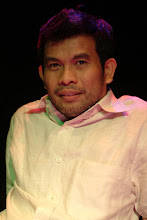
John-Mario Sevilla

Dance Residency Concert


presented by

University of Texas at Dallas


University of Texas at Dallas
University Theatre
800 W. Campbell Rd.
Richardson, TX 75080-3021
click here for a location map


Oh-oh, video. (Now sing-song oh-oh, videothree times.)

Video sprouted up in every modern and contemporary work I have seen in the last few weeks, so when the back of the stage at the University Theatre at the University of Texas at Dallas lit up with images of roses and sea urchins Thursday night, my reaction was, oh-oh, it better be good.

Not to worry, however, as that was just a teaser, along with the sound track of a rooster crowing and other extraneous noises. Of the six works on the program, only one relied on video.

Exactly how we were to take the introduction of each dance beats me. A dancer swaggers to the front of the stage, pulls out a pen, and leans down on a long pink path and scribbles invisible marks. That is repeated at the beginning of every work, sometimes with two dancers marking the floor.

But other than that silliness, the show got off to a fine start with UT faculty member Michele Hanlon’s A Hundred Back Doors. Five dancers in peasant dress appear in a pool of light, making big, broad gestures, arms scooping the air and legs planted wide. As light covers the stage, they fan out. At the center, however, remains Rigoberto Hernandez, sturdily stationed in one spot as he swings arms wide and rotates his shoulders. His long, thick black hair flies too.

He is quite the most arresting dancer, bringing a much-appreciated masculine energy, more like a force of nature—a workhorse—than a sleek dancer.

Path, choreographed by faculty member and director Micki Saba, never got off the ground, although the initial arrangement of three duos and a loner sparked curiosity. Eventually, they disperse and cup hands as though to catch something in the air. At one point, they butt up against each other, or step over a pile of dancers. The music—clamorous and shrill—adds tension.

If nothing else, guest artist John-Mario Sevilla and Zubin Mohamad’s fruitcake of a dance, Pie in the Sky, was worth the price of admission (though Thursday’s performance was free)—so clever that even gag jokes took on a surreal air. With Kim Corbet sitting at one side of the stage hitting drums and gongs, Sevilla and Mohamad strode in carrying a large crate. (Just for some background, New York City-based Sevilla met Mohamad, based in Malaysia, at a hula concert, hit it off, and made plans to get together. Pie in the Sky is the happy result.)

Crate parked at the front of the stage, they return to place a small red box on top, of which we will later learn the contents.

The next trip brings a big, crinkly blanket, spread out picnic-style. Under it are two foil-wrapped containers. The men sit, open the containers and begin to eat what look like hardboiled eggs, making a big mess. One shoved food into the other’s gullet, getting more out of control. Food eaten, they grab the tinfoil plates and hit legs, knees and chest with giddy whacks. Soon they are chasing each other using the plates as weapons.

The look of youthful glee and spurts of dismay continues in this vein, building up when Mohamad lies hidden under the blanket turned into a tent. When he emerges, he’s wearing nothing but tiny red thong underwear with two lime-green dildos stuck in his pants. Sevilla pulls out his brown dildos, and once again, the two are slapping and tormenting each other.

They remember the red box, open it and find a cake. Of course, it gets shoved into Mohammad’s face before Sevilla decides he wants a bite too. That they can keep the gags going with such surprise and freshness gives one hope that far-out dance has room for fun.

The rest of the program was just icing on the cake, with standout performances by Danielle Marie Georgiou and Hernandez in Rebecca DeButts’ Physical Dyslexia, and again stand-out performances in Sevilla’s Hushaboom, performed by guest artists Erin Dudley, Vernon Scott and Sevilla. Not as whacky as Pie in the Sky (and the only dance with video projections), Hushaboom tossed out cartwheels, dancers lying on the floor with ankles intertwined, and slaps and runs.

Sevilla’s Las Lineas used Latin rhythms to give the seven dancers in the UT Dallas Dance Ensemble the chance to let loose.

Margaret Putnam has been writing about dance since 1980, with works published by D Magazine, The Dallas Observer, The Dallas Times Herald, The Dallas Morning News, The New York Times, Playbill, Stagebill, Pointe Magazine and Dance Magazine.


Comments:

John-Mario Sevilla writes:
Saturday, March 12 at 12:19PM

Thank you, Margaret and TheaterJones, for your thoughtful response and review. I just want to mention that I collaborated with Zubin Mohamad in creating "Pie in the Sky." He shares the credit and responsibility for the creative and performance choices of this dance. Respectfully, John-Mario Sevilla

Margaret Putnam writes:
Saturday, March 12 at 1:06PM

Dear John-Mario, I am so sorry I left out Mohamad's name. I happen to hate the cake smashing in general, but in Pie it was just right. Margaret Putnam

Tuesday, November 30, 2010

Hanuman and Flowering in Transtory@Culver Art Centre, Riverside, California

It has been two months since I came to University of Riverside, California at the Dance Department, teaching Dance Culture-Culture in Dance to undergraduate students. At the same time, I am also working on dance pieces - triple bill as part of collaboration with Wendy Rogers(professor of dance at UCR) entitled TRANSTORY, to be presented at Culver Arts Centre on January 6, 2011. Apart from our collaborative work entitle FLOWERING, I will be presenting another piece called HANUMAN, a work that I started back in Malaysia, presented at MASKARA, GAPENA in January and KL FRINGE FEST@MAPKL in April 2010. The small work in Kuala Lumpur was a collaborative project with voice by Asmidar Ahmad, an award winning singer at various singing competition in Malaysia and also Los Angeles. The original work in KL was a solo dance performance while the HANUMAN here in Riverside would a group choreography. At the moment I am working with 3 in 1 HANUMAN and Rama(Seri Rama) representing the Father Sky and Sita(Siti Dewi) representing the Mother Earth.

Tuesday, September 21, 2010

Svarnabhumi in The Sun

Tue, 21 Sep 2010
TIME OUT :: Entertainment
Dancing in new pastures
Bissme S.

Dancer/lecturer Zubin Mohamad’s passion for dance has taken him to foreign shores where he is doing what he loves to do most

MALAY
contemporary dancer cum lecturer Zubin Mohamad is teaching dance at the University of California in the United States – something he is unable to do back home. He is there for a six-month stint under a Fulbright scholarship.

The 46-year-old dancer is also likely to put up performances in several cities in the US, including New York and San Francisco.

Most Malay dances require your feet to touch the earth as
this creates a special spiritual bond between the dancer
and the earth."
– ZubinMohamad

Zubin had taught dance in two institutions in Malaysia but he ended up in departments that did not directly deal with dance.

"In one university, I was transfered to the theatre department and in the other, I was asked to give dance theory lessons," says Zubin, who has a PhD in Political Economy of Contemporary Arts (Malay Dance Theatre).

"I wanted to mould young minds. I wanted to do choreography. I wanted to be on the dance floor. But I was not given a chance to do this in my own country.

"But nobody can stop me from dancing as it is in my blood."

Zubin has won a few prestigious arts awards, such as the Asia Fellow Award in 2002, Unesco’s Artisan of Southeast Asia in 2000 and Rockefeller’s Southeast Asian Islamic Scholars Award 2003.

At the age of eight, he learnt zapin, a traditional Malay dance form, and at the age of 13, he picked up silat, a Malay art of self defence.

"My uncles are zapin dancers and silat experts," says Zubin, who was born and raised in Kelantan. "They also made drums. We performed at palaces and in front of royalty. Almost every wedding in Kelantan then had zapin and silat performances.

"But not any more. Things have changed. Now, people prefer to have Faizal Tahir (Malaysian Idol runner-up) singing at their weddings."

One can feel the disappointment in his voice when Zubin laments about Malay traditional dance forms not getting the proper recognition and respect they deserve.

Asked if tourism has given a new lease of life to the Malay dance forms, he replies: "Tourism has good and bad effects."

He says in Sarawak, "we’ve seen how tourism has revived some dying dance forms".

But, he points out, it has also led to some of these dance forms being simplified and commercialised to the extent that their real essence has disappeared.

"Sometimes, the tourism industry tends to emphasise more on costumes rather than the essence of the dance forms," he laments. "They’re more interested in glittering outfits and big head gears. Dancing is not about costumes only."

Zubin also dislikes the fact that some of the traditional dancers perform in sandals for tourists.

"Most Malay dances require your feet to touch the earth as this creates a special spiritual bond between the dancer and the earth," he says.

At the moment, he is doing research for a new project, which will touch on the Bujang Valley, an archaelogical site in Kedah, which has unearthed evidence of Hindu and Buddhist influences in the region.

"Malaysian historians have failed to tell us the truth," he says. "I’m sick and tired of people telling us that our country is very young. We’re not and our history didn’t start with the Malacca sultanate."

Some people are accusing Zubin of attracting unnecessary controversy by doing the Bujang Valley dance project.

"I’m not doing this for sensationalism," he insists. "I’m doing research on my culture and on my dance. We cannot deny that a lot of our art forms have Hindu and Buddhist influences. But they have gone through many Islamic transformation over the past century."

Being passionate about dance, he is frustrated that his home state of Kelantan has banned mak yong performances as the state government claims that it goes against certain Islamic teachings.

"There’s a lot of misconception about this dance form," Zubin says. "There should have been some kind of discussion before any decision was taken to ban mak yong."

SOUNDBITES

ON DANCE FORMS

"Dance should not be about looking beautiful and exotic. It should have some meaning and carry a message. You can give any message through dance – from corruption to terrorism. There’s always a message behind my dance. I never dance just to be beautiful and exotic."

THE KL FRINGE FESTIVAL

"I started this festival in 2007 to give young dancers a chance to become choreographers and to perform solo acts. It aims to add some excitement to the dance scene in Malaysia. The festival is held on April 28, which is also World Dance Day."

ON THE PRESENT DAY CHALLENGES

"One of the challenges I faced when I started the The KL Fringe Festival was when another organiser held a dance festival in the same month. To make matters worse, they stole dancers from my festival. Of course, they were bigger and had better resources. Their festival got better media coverage too but why did they want to compete with me? As artistes, we should be working together, not against each other."


Updated: 11:20AM Tue, 21 Sep 2010
Printable Version | Email to a Friend

Wednesday, July 21, 2010

Langkasuka Art and Orange!

I am sure you have read my article, Evernescent Kingdom, Everlasting Spirit: Seeking Langkasuka(edited by Alex Kerr of Bangkok Found and Lost Japan), available online for people to read. That article was written after my research on Langkasuka, in North Peninsula and South Thailand, after heated discussion with Late Nik Rashiddin, the woodcarver and Malay Classical Art thinker! I love having conversation with him about the old world, Nusantara (the archipelago).

I would like to continue my writing after that article, but when people stole the piece and made a book "Spirit of Wood", I became less motivated. However, I continued my own research to North of Thailand, Laos, Cambodia, Myanmar - Yangoon, Pego, Mandalap, Bagan, Indonesia, Philippines (except that I have not been to Mindanao and Palawan, but I collected few stuff from there). I wrote few popular writing pieces in Indonesia about my discovery on Majapahit and Sri Wijaya in local papers and magazines. But until now, I have not written anything on that subject since 1999. Having said that, I finally received my phd in 2006, having completed my thesis in 2004. Such as rules and regulations in our world that we have to be patience to receive what deserved.

Last year, 2009, I decided to go back to my own work, looking at Archaeology, combining with my dance, looking at "Lembah Bujang" sites that had been abandoned for many decades since independence. This time is to interpret the space through "feel"(rasa) and "soul"(jiwa) connection with the space. Now I am working on new dance theatre piece "Archaeology of Hidden Memory", hopefully it will be staged in US in the near future.

Recently also I found a Malay art piece, silver triangle to cover the young boys part "Caping" and I was told that they are from Laos, but they were also used in the Malay world, esp my part of country, Kelantan as Kelantan people are originally Mon-Khmer people, coming from the north, believed to be Yunan(South China) and Funan(the first Malay kingdom, older than Champa). Mon people are from north-western part of Peninsula Malaya

Thursday, May 06, 2010

HANUMAN HANUMAN STORY OF MONKEY KINGDOM

BUILDING HANUMAN, CHECK OUT THIS PAGE

http://www.sanatansociety.org/indian_epics_and_stories/the_life_of_hanuman.htm

Monday, March 22, 2010

Doa at ANNEX's Caesar Chong Memorial

Annex, Kok Man and Kuan Nam who actually asked if anyone would like to perform for Caesar Chong Memorial at ANNEX Central Market. I quickly said I would like to contribute a small a small performance. Then I decided to choose Kenang Daku Dalam Doamu, by M.Bakri, an old song from the 60s, later performed again by Sharifah Aini. Though I like M.Bakri's version very much, I like to give a different feel to it and managed to get Asmidar Ahmad, Music (Vocal) BA student at ASWARA to agree to sing without music. I tot her rendition was wonderful it managed to caprure the emotion and my feeling at the time. After she finished the song, she came in crying and thanking me for giving her the opportunity to sing and to provide her such emotion in the dance. To me, I feel that were in the situation, feeling sad over the departure of a dear friend, a very talented artist, dancer(butoh dancer with Nyoba Dance). Few days later Dr.Wong Ai Min asked me, do you know him? Have you worked with him? which I thought was a very funy question. Frankly, I have watched him perform since he started dancing with Nyoba. In fact, even before I started KL Fringe Festival, we have talked about making work together, and I asked him again to perform for KL Fringe 2009 but he was not able to do it. But like Pang said at the beginning of the memorial, he has inspired many people with his arts and isn't that what it's all about, giving inspiration to others. Caesar, you have given us beautiful and inspiring memory. God Bless You

Sadly, I was not able to meet up with people attended the affairs as I have to leave for the closing of KL Fringe Film at Menara DBP at 10.30PM.

Tuesday, March 16, 2010

TANAH SERENDAH SEKEBUN BUNGA


"TANAH SERENDAH SEKEBUN BUNGA" (TSSB) karya tulisan dan arahan oleh Zubin Mohamad a.k.a Zulkifli bin Mohamad telah dipentaskan di Stor Teater, Dewan Bahasa dan Pustaka pada tahun 2004.

‘Tanah Serendah Sekebun Bunga’

TSSB adalah sebuah teater tari yang direkonstruksikan dalam persembahan kontemporari berinspirasikan seni pertunjukan klasik, Mak Yong, Wayang Kulit, Main Peteri serta pertunjukan vocal Dikir Barat. Nama TSSB diambil dari cerita-cerita yang dimainkan dalam seni pertunjukan klasik tentang sebuah ibukota kerajaan dahulukala. Kerajaan tersebut yang dipercayai bernama ‘Langkasuka’ adalah kerajaan yang disebut sebagai ‘Golden Kersonese’ dalam catatan-catatan perjalanan para pengembara Eropah. Nama TSSB menjadi popular di Kota Bharu, Kelantan berhadapan dengan Istana Balai Besar, walaupun tempat yang dikatakan bukanlah berada di situ. Dalam kajian Kelantan serta kajian sejarah awal Malaysia, Kerajaan tersebut berada di Ulu Sungai Kelantan yang berkemungkinan adalah di kawasan Sungai Pergau, kerana di situlah juga terdapat lombong-lombong emas yang terkenal. Alkisah, Langkasuka pernah diperintah oleh Raja Perempuan yang bernama Raja Mas Chayam, begitu juga dengan Negeri Kelantan yang pernah diperintah oleh Che Siti Wan Kembang dan Puteri Saadong dalam abad ke 17, sama juga dengan Negeri Pattani di Selatan Thailand sekarang yang pernah diperintah oleh empat orang Permaisuri dalam abad ke 16 dan 17. Langkasuka adalah sebuah kerajaan termashyur meliputi Chaiya di Utara Bahagian Selatan Thailand hingga ke Riau pada abad pertama sehingga abad ke 14, pernah menjadi sebahagian dari Kerajaan Majapahit yang beribukota di Trowulan, Jawa Timur. Kerajaan tersebut juga banyak dipengaruhi Kerajaan Melayu Champa, Funan serta Angkor antara abad ke 6 hingga ke 12.

Cerita Tanah Serendah Sekebun Bunga mengisahkan perjalanan Raja Perempuan Raja Mas Chayam melawat rakyat jelata dalam negeri baginda dan bertemu dengan seorang lelaki yang sedang sakit. Beliau dikatakan sering bertemu dengan dua orang puteri raja dari daerah benua yang berbeza. Setelah melalui pengobatan tradisi Main Puteri dapatlah berhubung dengan kedua puteri – Puteri Siti Zubaidah Champa dan Ratu Laut Selatan Di Jawa yang memberitahu bahawa Kerajaan Langkasuka akan diserang oleh kerajaan-kerajaan besar nusantara. Raja Mas Chayam segera pulang ke istana baginda dan mengerah menteri-menteri untuk bersedia menhadapi perang yang akan bermula. Tapi malangnya negeri Langkasuka diserang musuh sebelum angkatan perang bersiap sedia. Langkasuka dinodai, kekayaannya dirompak, ramai rakyatnya dibunuh dan dijadikan tawanan perang, manakala raja perempuannya yang turut turun berjuang di medan perang tidak dijumpai mayatnya Langkasuka menjadi ‘Padang Jarak Padang Tekukor’, sejurus itu hujan lebat ribut petir angin tengkujuh melanda Negara Langkasuka, negeri yang kalah perang itu menjadi bertambah kacau bilau dan dikatakan tenggelam dan hanyut ke laut.

Dramatari TSSB digubah dalam beberapa babak:

  1. Cerita Titih Nagara Langkasuka ( Wayang, Dalang dan Bayang)
  2. Bele Bele Bejalan ( Raja Mas Chayam Melawat Nagara)
  3. Puteri-Puteri Turun Menari (Main Peteri)
  4. Angkatan Perang Cerang Tegayung ( Silat , Wayang, Dalang dan Bayang)
  5. Memanggil (Mengadap Rebab Makyong)

Tanah Serendah Sekebun Bunga: The Director’s Note

The work is a collaborative in nature. When I expressed my idea of staging TSSB to Hamzah Tahir (dancer-actor, choreographer, director, scenographer, educator), he agreed to work with me and to include another fellow actor Mazlan Tahir, whose works with Silat, also an artistic director and educator. When I wrote the storyline and performance script, it was quite clear that I wanted to include the various forms of Malay performance such as Mak Yong, Wayang Kulit, Silat and Manora. While both Hamzah and Me are very keen on making contemporary work, mixing modern movement, I am especially passionate with classical Malay dance theatre. In TSSB, I was not trying to re-enact the old forms but looking at them as interesting forms that are suitable to various parts in the performance. ‘Bele-bele Bejalan’ dance from Mak Yong performance theatre is used as a dance to represent the journey taken by the Queen. In this performance, the Mak Yong primadonna is not playing the king, but the Queen, the lady ruler of Langkasuka Kingdom. The ‘Mengadap Rebab’ dance from Mak Yong is used as the last dance representing the feel and spirit of longing for the lost kingdom. Manora dance for example is used to represent the victory dance of the enemy which got Langkasuka defeated in a surprise war attack. The pseudo Javanese dance was used as the dance represented the spirit of ‘Ratu Laut Selatan’ who appeared in the dream of Sang Rajuna, a loyal and humble being of Langkasuka. Silat of the martial art nature is used in the scene of Angkatan Perang Cerang Tegayong, closed to its nature, representing the preparation of an army troupe. The first dance in the first scene of Titih Cerita is contemporary and modern in nature, using traditional dance motives in contemporary composition, new world Asian music with fresh sound, wearing white costumes wrapped with clear white plastic as sarong, and at the same time produced the sound of frictions – the displeasure and uneasy feel of losing own culture and heritage, crushed with the idea of development, modernization and globalization. It is a dance of a present day generation, trying to look at old tradition and heritage. The collaboration with the traditional performers of Mak Yong, Wayang Kulit and Manora is a very delicate process, where a lot of time would be needed and they also have a set mind of performance. With that in mind, very little could be engaiged from them, especially within limited time, space and money. Among the three of us, Hamzah, Mazlan and Me, we divided the scenes and rehearsed separately, we discussed the various aspects from the very beginning, including the costumes, set and lighting design. The work could be seen as a juxtaposition of many different styles and forms by traditional theatre practicioners or collages of visual images by purists. For that reason, we decided not to use the ‘true to tradition’ kind of live music, of Wayang, Mak Yong and Manora ensemble but only the sound of them mixed with live vocals from the storyteller – contemporary reading of a poem, singing of excerpt from Mak Yong and Wayang. The poem of TSSB tell the whole story about the kingdom were distributed to the audience, projected on a stone like figure, inspired by the inscripted stone (Batu Bersurat), only part of it was read in the beginning and the end of the performance. The scene of ‘Puteri Turun Bermain’ is a shamanistic dance in nature, inspired by Main Peteri healing performance where its formation is structured improvisation, also taken in the ‘Kuda Kepang’ dance, another shamanistic form. In fact, this part could be seen as the main part, the metaphor of ‘TSSB’ and Langkasuka Kingdom, now only exist in a mystic world.


Babak-babak dalam Tanah Serendah Sekebun Bunga

Cerita Titah Nagara Langkasuka

Babak permulaan ini akan membuka tirai penceritaan asal usul Nagara Langkasuka dan ibu nagaranya yang bergelar ‘Tanah Serendah Sekebun Bunga’. Dalam babak ini kita akan menyaksikan penggunaan dalang dan wayang dalam konteks dekonstruksi dan penggunaan tubuh pelakontari yang melahirkan bayang-bayang yang menarik. Gerak-gerak yang dilahirkan lebih menampilkan gerak kontemporari yang berlatarbelakangkan muzik wayang kulit Kelantan.

Bele-bele Berjalan

Babak ini menceritakan perjalanaan Raja Mas Chayam, bermula dari anjung istananya ke marata negeri sehingga bertemu dengan sebuah keluarga yang anak lelakinya sedang sakit dan tidak sedarkan diri. Baginda mencadangkan keluarga tersebut untuk mengadakan upacara pengubatan ‘Main Peteri’ sebagai satu usaha dan mengkhabarkan kepada baginda akan berita tentang si sakit. Babak bele-bele berjalan menggunakan konsep dan muzik Mak Yong, manakala babak si sakit akan menggabungkan repertoire ‘Main Peteri’ serta gerak-gerak kontemporari.

Puteri-Puteri Turun Menari

Babak in merupakan lanjutan daripada upacara ‘Main Peteri’ yang menyaksikan dua orang puteri dari sebelah utara di tanah besar, ‘Puteri Champa’ dan ‘Ratu Laut Selatan’ dari selatan Laut China Selatan, iaitu Laut Jawa tampil bergilir-gilir dalam dialog pengobatan si sakit, memberitahu si sakit tentang berita angkara yang akan melanda negeri Langkasuka dan Tanah Serendah Sekebun Bunga. Si sakit terus meracau di kelilingi pelakontari korus yang mengekspresi diri dalam gerak kontemporari. Berita angkara yang akan melanda negeri disampaikan kepada baginda Raja Mas Chayam.

Angkatan Perang Cerang Tegayung

Sebelum sempat Angkatan Perang Cerang Tegayung bersiap sedia menghadapi perang, istana dan ibu negerinya diserang dengan hebatnya, kekalahan teruk dalam perang yang tinggal hanya menjadi padang jarak padang tekukor disusuli dengan ribut petir beliong yang menghayutkan segala isi negeri ke laut. Babak ini menggunakan gerak-gerak persilatan yang berlatrbelakangkan muzik wayang kulit serta penggunaan bayang, dalang dan wayang.

Memanggil

Babak penutup dalam Tanah Serendah Sekebun Bunga ini merupakan sebuah upacara simbolik yang melambangkan kesedihan atas negara, raja dan rakyatnya yang hilang dan hanyut ke laut. Babak ini berinspirasikan geraktari ‘Mengadap Rebab’ dalam Mak Yong.

Tenaga Produksi ‘Tanah Serendah Sekebun Bunga’

Produksi ini diterbitkan oleh sebuah organisasi tanpa untung (Non-Profit Organisation), Arts Xchange Asia dengan kerjasama Fakulti Seni Pertunjukan, Universiti Institut Teknologi MARA serta Dewan Bahasa dan Pustaka. Produksi ini akan dipersembahkan oleh sebuah perkumpulan teater yang bergelar ‘Teater Sewarnabumi’ yang menggabungkan tenaga pengajar serta pelajar-pelajar terpilih dari FSP-UiTM. Antara tenaga pengajar yang terlibat termasuklah:

PRODUCER-DIREKTOR

ZULKIFLI MOHAMAD

PENASIHAT

ASOC.PROF. ROSINI

SKENOGRAFER

HAMZAH TAHIR

LIGHTING

AZAHAN ABDUL RANI

SOUND

SYAHARUL

VIDEO

HAFIZ

HISHAM

KOREOGRAFER

MEK NAB

HAMZAH TAHIR

ZULKIFLI MOHAMAD

MAZLAN TAHIR

PERFORMERS

MAZLAN TAHIR

HAMZAH TAHIR

MEK NAB

KIPLI A.RAHMAN

DALANG ZAKARIA

HASANOL

REZAL

ARINA

ARDILLA


Saturday, February 13, 2010

Making Gazelle Rain Petals at MPO 20 Feb 2010

Gazelles are known as swift animals – some are able to maintain speeds as high as 50 miles per hour (80 km/h) for extended periods of time. Gazelles are mostly found in the deserts, grasslands and savannas of Africa, but they are also found in southwest and central Asia, and the Indian Subcontinent. They tend to live in herds and will eat less coarse, easily digestible plants and leaves.

Gazelle is derived from the Arabic ghazăl (Arabic: غزال). Arab people traditionally hunted the gazelle. Appreciated for its grace, it is a symbol most commonly associated in Arabic literature with female beauty. One of the traditional themes of Arabic love poetry involves comparing the gazelle with the beloved, and linguists theorize that ghazal, the word for love poetry in Arabic, is related to the word for gazelle. It is related that the Caliph Abd al-Malik (646-705) freed a gazelle he had captured because of her resemblance to his beloved:

O likeness of Layla, never fear!
For I am your friend, today, O wild deer!
Then I say, after freeing her from her fetters:
You are free for the sake of Layla, for ever!

Currently, the genus Gazella is widely considered to contain about 13 species.Our further species are extinct – the Red Gazelle, the Arabian Gazelle, the Queen of Sheba's Gazelle and the Saudi Gazelle. Most surviving gazelle species are considered threatened to varying degrees. Fossils of genus Gazella are found in Pliocene and Pleistocene deposits of Eurasia and Africa. Gazelles disappeared from Europe at the start of Ice Age, but they survived in Africa and Middle East. Four species became extinct in recent times due to human causes.

www.wikipedia.com


SIX local composers will showcase their original compositions for a chamber ensemble in a special hour-long concert to be held at the Dewan Filharmonik Petronas in KLCC on 20 February 2010.

These talented composers are Tzu-En Ngiao, Wong Chee Yean, Zihua Tan, Wong Chee Wei, Isaac Chia and Isabella Pek.

MPO Forumplus, an offshoot of the extremely successful and long-running MPO Forum for Malaysian Composers. MPO Forumplus follows on from six years of the MPO Forum activity that has, to date, produced 30 new orchestral works from 12 Malaysian composers.

This non-competitive evolution of the Forum is a unique platform for established and emerging composers to refine their craft, establish new practices, make new contacts and work with the country’s best musicians.

It is hoped that in so doing, they get to create new works that will further enhance Malaysia’s burgeoning art scene.

Running for two years, each composer is assigned to an individual MPO musician who acts as a mentor and advisor.

Each candidate will present a chamber work in this concert before composing for a larger orchestration of some 100 musicians under Stage 2 of the MPO Forumplus, slated for February 20.

Field, who will also be the conductor for the concert, said that Forumplus is a wonderful platform for emerging local talents to engage in knowledge transfer and the exchange of ideas.

“Opportunities like these are rare. Not only do they get to write for a professional orchestra, they will also work closely with MPO musicians for nine months, and have their compositions played at the DFP. It’s a real luxury and this does not really happen anywhere else in the world.”

When asked on the compositions that the six will be presenting for the concert, Brophy, who was also on the panel of the previous MPO Forums, said he had found new things in all the pieces.

“There may be ideas that we have not heard before, especially for me since I’ve listened to many kinds of music scores and compositions. While there is a plethora of influences in their works, which is normal, the style is still Malaysian.”

Rehearsals for the big day started last Tuesday and everyone received the same amount of rehearsal time, regardless of how complex their compositions might be.

While there will be recording for archival purposes, there are also plans to compile the compositions in an album if the demand is there.

For ticket bookings, call DFP BoxOffice at 03-2051-7007.

The six composers include:

Tzu-En Ngiao, 32, from Penang. Ngiao completed his Master’s degree in electronic engineering at Britain’s Hull University, and worked for five years in the semi-conductor design industry. He is pursuing graduate studies in music composition under Johan Othman and, linking it with his engineering background, has developed a composition technique in which ideas are constructed and organised in a mathematically precise manner but imbued with poetic vision and expression. His recent works include Inconsequentials for piano and The Quiet Affinities of Undissolved Lights for flute, piano and woodblock.

(MPO date for six By HIZREEN KAMAL NST 2009/06/12)

Tuesday, November 10, 2009

Berlari Mengejar Terompah: Dari Annexe-DBP-ASWARA ke Kuala Selangor(UITM)


Ada email dari teman Indoensia yang berada di negeri penuh salji waktu ini, US-Minnesota, yang bertanya apakah dia sudah tersalah cakap atau tersalah laku, tapi ternyata tak ada dan tak pernah, mungkin aku yang ada pernah ngomong yang salah, kerana mulut ku emangnya dibilang "Big Mouth", nothing to hide about what I like and what I don't like. But frankly, in the past few weeks aku sibuk banget, dengan permohonan bantuan kewangan dari kementerian kebudayaan dll yang tidak mudah, kerana banyak yang diperlukan, tempat dance talk yang berubah tarikh dari 4 Nov ke 3 Nov kerana double booking oleh orang2 di Annexe, sehingga aku terpaksa bercakap dengan 3 orang pekerjanya(talking about co-ordination and delegartion!!). Rasanya bukan aku yang harus bercakap dengan 3 pekerjanya. Seharusnya aku cuma bercakap dengan satu orang saja. Worse kepalanya didn't book me, for whatever reason, on top of saying confirmed. Now aku tahu, dalam negeri ini kata tak boleh dipegang sebagai janji, perlu ada agreement, dalam tulisan. Kita semakin jauh menjadi Melayu/ Malaysia, walaupun mereka bukan orang Melayu. Tapi benda yang sama berlaku di organisasi Melayu kerajaan, DBP yang juga double book venuenya, Balai Syed Nasir. Jadi terpaksalah mencari venua lain, walaupun tak sedap hati dengan kawan aku kat situ. Nasib baik jugaklah ASWARA bersetuju dan ada tempat. Terima kasihlah En.Amir Hakim dan Puan Balkis dari Teater. Dapatlah guna Black Box.

Tapi sebenarnya bagus juga buat kat situ, ramai pelajar yang boleh datang tengok karya2 yang berbeza dari apa yang sering dipertontonkan dalam Jamu DSB di ASWARA. Pelajar2 dari dua kelas Pengajian Budaya 2 dan Sejarah dan Falsafah Seni datang, tapi tak ramai pelajar dari Pemikiran Kreatif dan kritikal yang datang, maklumlah dah besar panjang, ada pemikiran sendiri dan sibuk agaknya. Di facebook aku dok cakap2 kata kawan2 ramai janji nak datang, tapi tak datang, itulah baru tahu, facebook tu cuma tempat bermain kata2 dan janji2 tapi bukan bermakna apa2, begitu juga yang kata kawan dalam atau friend dalam tu, sebenarnya bukan kawan, itulah dalam bahasa Inggeris ada bezanya antara kenalan, rakan, kawan dsb. Apapun aku nak ucapkan terima kasih atas sokongan semua pihak walaupun payah, tapi itulah hakikatnya!

Tapi semuanya berjalan lancar dengan bantuan students, staff dan kawan2. Terima kasih kepada semua koreografer-penari-performer, Ananya yang datang jauh dari Uof Minnesota, US, Pak AGI dari UITM Shah Alam, Mek Nab yang tampil dalam karya aku, juga dari Shah Alam bersama dua pelajarnya yang datang sejak pagi lagi untuk latihan dan jamming session, Suhaili yang sibuk, begitu juga dengan Rathimalar yang membawa rombongan kawan2 dan keluarga, Dayang Mariana yang menampilkan Mohar dalam karyanya(takut aku tak tahu macamana nak bayar dia, tapi dia yang undang, itu bukan soal aku kan!!!), Kuan Nam yang sibuk dengan kelas yoganya di Pahang. Aku sendiri yang kena buat semua benda.

Apapun semuanya berjalan baik, termasuk talk yang walaupun cuma ada 13 orang yang datang, tapi penuh bermakna seperti kehadiran Ramli Ibrahim dan kawan2 lain termasuk Roziana Aziz dari Astro Awani, Reza Zainal Abidin, dalam hujan ribut tuh, serta Fringe Excursion ke Lembah Bujang bersama Ananya.

This weekend aku kena siapkan projek dengan pelajar2 UITM Produksi Teater Moden yang akan menampilkan "Terompah Manik", shooting teater ke dvo, sesuatu yang baru di sini tapi tidak baru di dunia. Ini terjadi kerana katanya pelajar tidak boleh mementaskan karya di luar(sesuatu yang pelikkan). Untuk seorang seniman, kita harus terus mencari peluang dan ruang, itulah lahirnya idea tersebut.

Sunday, November 01, 2009

Projek KL Fringe 2/2009 - Metro Ahad

myMetro » Rap
Click Here

Festival seni


Rap
FESTIVAL seni berskala kecil, KL Fringe, kembali lagi tahun ini. Menggabungkan teater, muzik, filem dan tari, festival ini dilihat sebagai platform untuk pengkarya antarabangsa berkongsi pentas di Kuala Lumpur.

Menurut Kurator KL Fringe, Dr Zulkifli Mohamad, Fringe Festival selalunya menjadi festival seni di samping festival besar seperti di Edinburgh, Adelaide dan Minnesota.

“Memandangkan keadaan ekonomi tidak memberangsangkan tahun ini, kami hanya mampu mempersembahkan program siri Teater Tari (Danstheater Series) yang menampilkan tujuh pengkarya dalam persembahan 20 hingga 30 minit.

“Siri Teater Tari KL Fringe mempersembahkan Cetus pada 6 dan 7 November ini di Aswara. Terlebih dulu, pada 3 November diadakan sebuah persembahan syarahan oleh Prof Ananya Chatterjea dari University of Minnesota, di Annexe Gallery, Pasar Seni, Kuala Lumpur pada jam 8.30 malam,” katanya.

Menurut Zulkifli, KL Fringe ini bakal memeriahkan lagi kegiatan kesenian di Kuala Lumpur, sekali gus mempopularkan genre teater tari serta pengertian Timur dan Barat dalam gaya moden dan tradisi. Apa yang menarik katanya adalah karya yang ditampilkan oleh Zubin Mohamad meletakkan Mak Yong dan Manora bersama.

“Danstheater diambil dari kata Tanztheater yang berasal dari Jerman. Ia seterusnya menjadikan persembahan teater tari untuk menarik perhatian penggemar tari kontemporari dan teater,” katanya.

Cetus turut menampilkan Rathimalar yang lama bergiat bersama Ramli Ibrahim dan Sutra Dance Theatre, Suhaili Ahmad Kamil yang hangat dalam You Think You Can Dance? musim pertama dan Kie Kuan Nam (Nyoba Dance).

Carian Artikel